

THE SHORT ANSWER
Do not spend the whole conversation proving your teen was wrong.
Name the behavior and the boundary, then ask your teen to walk you through what they were thinking before, during, and after the decision. Listen long enough to identify the pressure, goal, fear, or assumption behind the choice. Then connect the consequence to safety, repair, or rebuilding trust.
WHAT OFTEN GOES WRONG
Parents keep arguing the verdict after everyone already knows the verdict.
When a young person has lied, broken a rule, or taken a risk, the parent’s anger makes sense. But repeating “You knew better” or “What is wrong with you?” usually produces defensiveness, silence, or a performance designed to end the lecture.
The American Academy of Pediatrics advises parents to listen without immediate judgment, avoid catastrophizing, and avoid lectures that teens are unlikely to absorb. CDC guidance similarly emphasizes active listening, open communication, and fair, consistent boundaries.
THE YOUTHPIVOT FOUR-STEP CONVERSATION
Accountability works better when the conversation produces usable information.
Regulate before you investigate
If either of you is still heated, pause. A short reset is not avoidance. It is preparation for a conversation where your teen can think and you can listen.
“We are going to address this. Let’s both cool down first, then talk at 7:00.”
Name the known facts and the boundary
Be direct about what happened without stacking on character labels. Separate the behavior from the young person so accountability does not become humiliation.
“Leaving without permission was unsafe and it broke our rule. We need to understand the decision and decide what happens next.”
Reconstruct the decision, not just the violation
The most useful information is often what your teen expected, feared, wanted, or failed to notice before making the choice. Ask one question, then give them room to answer.
“Walk me through what was going through your mind when you made that choice.”
Connect the consequence to repair
A consequence should protect safety, rebuild trust, or repair harm. Ask for your teen’s view, but keep the final responsibility for a fair boundary with the adult.
“What do you think needs to happen to repair this, and what will help prevent it next time?”
QUESTIONS THAT REVEAL THE DECISION PATH
Ask one. Wait. Let the answer lead to the next question.
“What was happening right before you made that choice?”
“What did you think was going to happen?”
“What felt most important to you in that moment?”
“When did you realize this was going in the wrong direction?”
“What could help you make a different choice next time?”
WHAT ACCOUNTABILITY CAN SOUND LIKE
Keep the boundary. Remove the humiliation.
You can listen carefully and still make it clear that the behavior was unsafe or unacceptable. CDC guidance on parental monitoring recommends clearly explained rules, fair and consistent consequences, and an open relationship where teens believe their parents can be trusted and will listen.
“I understand what you hoped would happen. I also need you to understand why this was unsafe. The consequence is still happening. We are going to use it to rebuild trust and make the next decision safer.”
HEAR THE METHOD IN RON’S OWN WORDS
A 47-second field note for parents.
Ron explains why he moves past proving the mistake and asks a young person to explain their reasoning instead. That is where prevention begins.
Open on YouTubeWHEN YOU NEED A BETTER OPENING
Keep 72 focused parent-teen questions ready.
Teen Conversation Cards gives you calm starting points across trust, school, friends, online safety, emotions, and choices. Use one question in a low-pressure moment and let the answer guide the conversation.
See the Teen Conversation Cards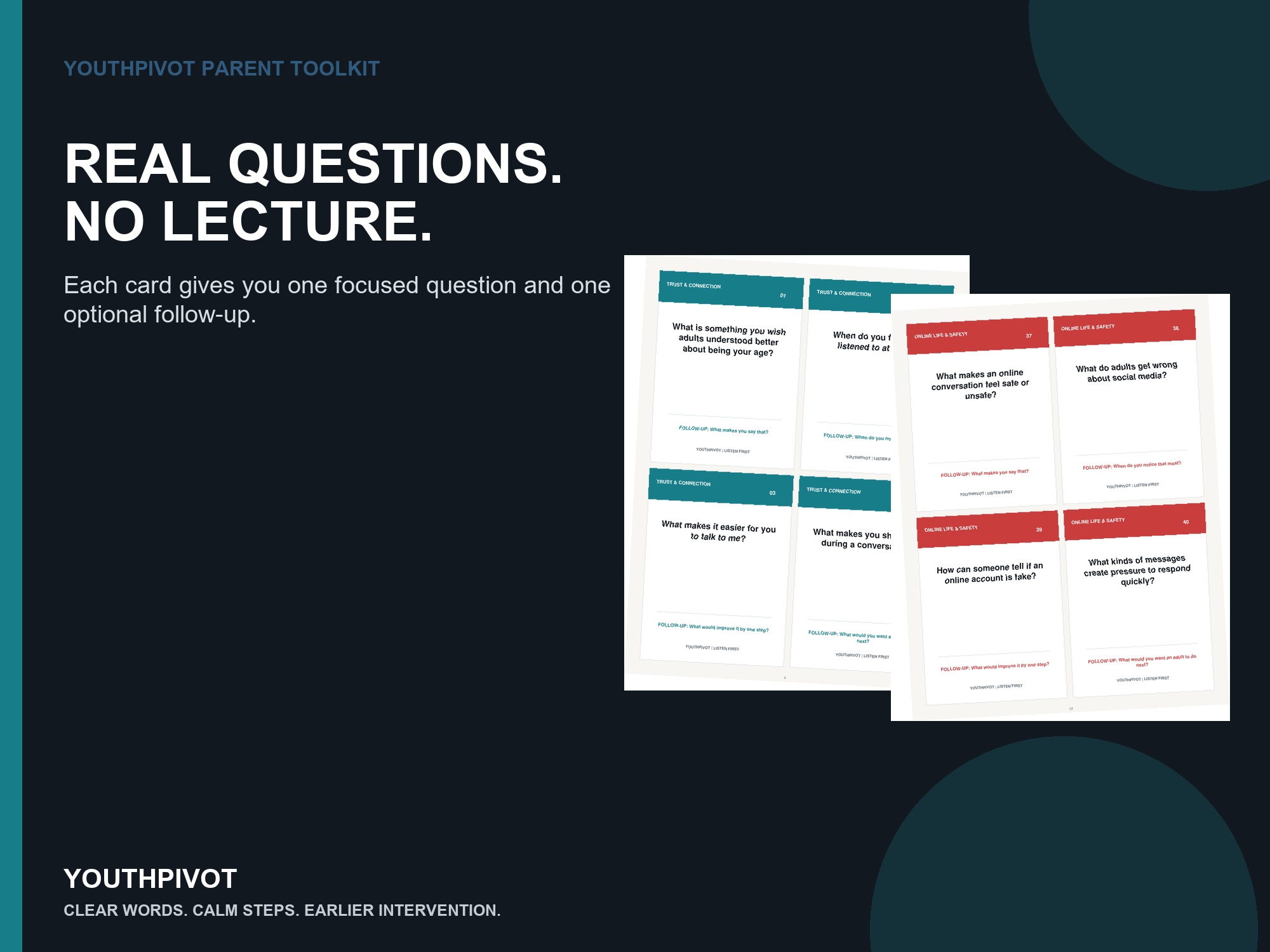
WHEN A CONVERSATION IS NOT ENOUGH
Move from conversation to qualified help when safety is at risk.
Seek immediate or professional support for violence, threats of self-harm, abuse, exploitation, serious substance use, repeated running away, or any situation you cannot safely manage. If there is immediate danger, call emergency services.
PARENT FAQ
Questions parents ask after a teen makes a serious mistake.
Should I give the consequence before asking questions?
If immediate safety requires a boundary, set it right away. When possible, learn the decision path before finalizing the full consequence. That information can help you choose a response connected to safety, trust, or repair instead of reacting only from anger.
What if my teen keeps saying “I don’t know”?
Slow the conversation down. Ask about the sequence instead of demanding a motive: What happened right before it? Who was there? What did you think would happen? If your teen is overwhelmed, set a specific time to return to the conversation rather than forcing an answer in the moment.
Does understanding the reason excuse the behavior?
No. Understanding explains the decision process; it does not erase the boundary or the harm. Parents need both pieces: enough information to interrupt the pattern and enough follow-through to make the expectation clear.
Should my teen choose their own consequence?
Invite their input because it shows how they understand the harm and what repair might look like. The parent still decides whether the consequence is safe, fair, related, and realistic.
When is a parent conversation not enough?
Seek qualified help when there is immediate danger, violence, threats of self-harm, abuse, exploitation, serious substance use, repeated running away, or behavior you cannot safely manage. Call emergency services for an immediate emergency.
SOURCES & METHODOLOGY
How this guide was built
The conversation method reflects Ron Million’s frontline work with youth and families and motivational interviewing practice. Public guidance below supports the listening, emotional regulation, communication, and consistent-boundary principles used in this guide.
- American Academy of Pediatrics: How to Communicate With and Listen to Your Teen
- CDC: Conversation Tips for Connecting Conversations
- CDC: Parental Monitoring
- CDC: Coaching Teens to Recognize and Manage Emotions
This guide is educational and is not legal advice, clinical counseling, diagnosis, or a substitute for care from a qualified professional. YouthPivot does not represent Ron’s employer.